
Close

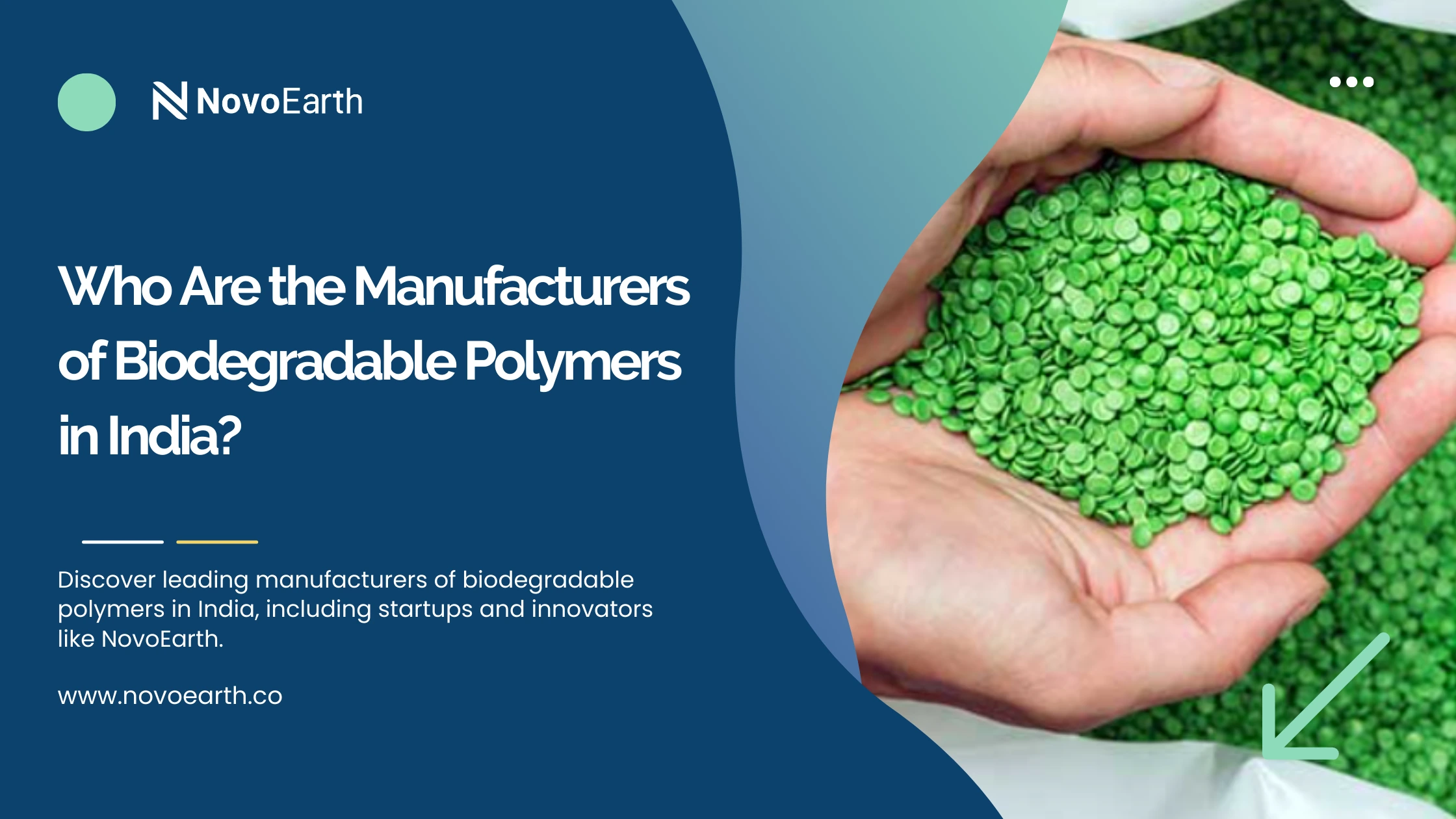
If you are a packaging company, sustainability professional, startup founder, or researcher looking for alternatives to traditional plastic, you’ve likely heard about the rapid rise of biodegradable polymers.
India generates over 3.5 million tonnes of plastic waste every year, and a significant portion ends up in landfills or oceans. Traditional plastics take hundreds of years to decompose, contributing to microplastic pollution and environmental damage.
This is where biodegradable polymers come into play. These materials are designed to break down naturally through microbial activity, reducing long-term environmental impact. In recent years, several Indian manufacturers and startups have begun producing biodegradable polymers, helping industries transition toward sustainable materials.
In this blog, we will explore leading biodegradable polymer manufacturers in India, their technologies, and how companies like NovoEarth are shaping the future of sustainable materials.
Biodegradable polymers are materials that can break down into water, carbon dioxide, methane, and biomass through natural microbial processes.
Polymer Type | Source | Common Applications |
PLA (Polylactic Acid) | Corn starch/sugarcane | Packaging, 3D printing |
PHA (Polyhydroxyalkanoates) | Microbial fermentation | Medical implants, packaging |
PBS (Polybutylene Succinate) | Bio-based chemicals | Agricultural films |
Starch-based Polymers | Plant starch | Compostable bags |
The increasing demand for biodegradable polymers in India is pushing companies to develop innovative materials that reduce microplastic formation.
India’s biodegradable polymer industry is expanding due to several factors:
India has implemented single-use plastic bans in multiple states, encouraging industries to adopt biodegradable polymers.
Consumers and businesses are actively searching for eco-friendly alternatives to conventional plastics.
Sustainable material startups are attracting funding and partnerships from global investors.
Industries such as agriculture films, garbage liners, and poly mailers are adopting biodegradable polymers to reduce environmental impact.
India now hosts several companies working on biodegradable polymer technologies and sustainable materials.
Company | Focus Area | Key Applications |
Reliance Industries (Bio-based initiatives) | Sustainable materials R&D | Packaging |
Truegreen | Compostable plastics | Carry bags, packaging |
Envigreen Biotech | Starch-based biodegradable polymers | Retail bags |
Bakeys | Edible and biodegradable materials | Cutlery |
Greenworks | Compostable polymer materials | Packaging |
These companies contribute to the growing ecosystem of biodegradable polymer manufacturers in India.
Beyond large manufacturers, several Indian startups are developing advanced biodegradable polymer solutions.
These startups are accelerating the adoption of biodegradable polymers across industries.
Among emerging innovators, NovoEarth is developing advanced biodegradable polymer solutions designed to eliminate microplastic pollution.
By focusing on scalable solutions, NovoEarth aims to accelerate the transition from traditional plastics to biodegradable polymers.
The demand for biodegradable polymers is growing across multiple industries.
The biodegradable polymer market in India is expected to grow rapidly.
As innovation continues, biodegradable polymers will play a major role in reducing plastic waste and microplastic pollution.
Switching to biodegradable polymers offers several benefits:
Which companies specialise in manufacturing biodegradable polymers for medical use?
Companies working on medical-grade biodegradable polymers typically focus on materials such as PLA, PHA, and bioresorbable polymers used in sutures, implants, and drug delivery systems. Many global manufacturers operate in this field, while Indian research institutions and startups are gradually entering the space.
Can I find biodegradable polymer suppliers in India?
Yes. India has several biodegradable polymer manufacturers and suppliers, including startups and established companies producing compostable plastics for packaging, agriculture, and waste management.
Which Indian startups focus on developing biodegradable polymer solutions?
Several startups are working on biodegradable polymer innovation, including NovoEarth and other sustainability-focused material science ventures aiming to reduce plastic waste and microplastics.
What types of biodegradable polymers are commonly manufactured in India?
Indian manufacturers produce Biodegradable Polymers such as PLA, PHA, PBS, and starch-based polymers. These materials are widely used in agricultural films, compostable packaging, and sustainable products.
Are biodegradable polymers completely eco-friendly?
Biodegradable Polymers break down into water, carbon dioxide, and biomass under suitable conditions. They are more sustainable than conventional plastics but still require proper disposal systems.
How long do biodegradable polymers take to decompose?
Most Biodegradable Polymers can decompose within 3–6 months in industrial composting conditions, while some may take longer in natural environments.
Which industries are adopting biodegradable polymers in India?
Industries using Biodegradable Polymers include agriculture, e-commerce packaging, waste management, and healthcare applications.
How do biodegradable polymers help reduce microplastic pollution?
Properly designed Biodegradable Polymers degrade through microbial activity, reducing the formation of long-lasting microplastics.
Businesses worldwide are searching for scalable alternatives to traditional plastics. NovoEarth is developing advanced biodegradable polymers to eliminate microplastic pollution and support a circular economy.
If your organization is exploring sustainable polymer solutions for packaging, agriculture, or industrial applications, NovoEarth can help.
👉 Visit NovoEarth.co to learn more about our biodegradable polymer innovations and sustainable material solutions.
Sarthak Gupta is a Mechanical Engineer and the founder of NovoEarth, a cleantech venture specialising in circular material innovation and sustainable polymer solutions. His expertise lies in biodegradable polymer technologies and recycling systems for multilayer plastics—complex waste streams traditionally considered non-recyclable. With prior Research and Development experience in renewable energy and wind turbine design, Sarthak focuses on translating engineering innovation into scalable, commercially viable climate solutions.

