
Close

If you’re a manufacturer, brand owner, or sustainability-focused business, you’re probably under pressure to reduce environmental impact without compromising performance or cost.
The problem is simple:
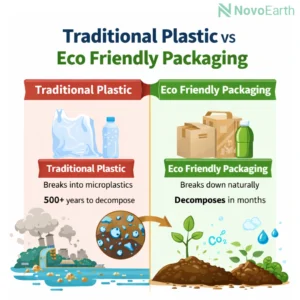
Most conventional packaging materials don’t degrade, create microplastics, and fail to meet evolving ESG and EPR regulations.
That’s where eco-friendly packaging comes in. In this blog, you’ll learn what eco-friendly packaging really means, how it works, and how businesses can adopt it without falling for greenwashing.
Eco-friendly packaging refers to packaging materials and systems designed to:
In simple terms, eco-friendly packaging is packaging that doesn’t become a permanent environmental problem.
Let’s cut through the noise—this is not just about sustainability branding.
If your business is not adopting eco-friendly packaging, you’re not just outdated—you’re exposed to regulatory and reputational risk.
Material Type | Sustainability Level | Key Advantage | Practical Limitation |
Biodegradable Polymers | High | Break down without toxic residue | Needs controlled conditions |
Recycled Plastics | Medium | Reduces virgin plastic demand | Quality degradation over cycles |
Paper-based Materials | Medium | Widely recyclable | High water & energy use |
Compostable Materials | High | Supports organic breakdown | Infrastructure limitations |
Bio-based Polymers | High | Lower carbon footprint | Cost sensitivity |
👉 Reality check: Not all “eco” materials are equal. Many just shift the problem instead of solving it.
Breaks down into natural elements within a defined timeframe.
Can re-enter the production cycle efficiently.
Consumes less energy during production and disposal.
Designed to avoid fragmentation into persistent microplastics.
Let’s be blunt—switching to eco-friendly packaging is not plug-and-play.
If you choose the wrong material, you may end up paying more without solving the actual problem.
Most companies talk about sustainability. Very few solve material science problems.
👉 NovoEarth is not just offering eco-friendly packaging—it’s building a circular material future.
If your packaging still ends up in landfills for decades, it’s not eco-friendly packaging—no matter what the label says.
Leading players include innovators such as NovoEarth, which focuses on biodegradable polymer solutions and circular materials rather than recycled alternatives.
Options include:
Costs are decreasing as technology scales.
Biodegradable polymers are among the most effective because they:
Yes, but only with advanced material engineering. Basic alternatives often fail at scale.
Not entirely—but it significantly reduces long-term environmental impact when implemented correctly.
You can find manufacturers through B2B platforms, industry directories, and sustainability expos. Companies like NovoEarth are developing advanced compostable polymer solutions for industrial use.
Common materials include:
Look for suppliers with certifications like CPCB, EN 13432, and ISO 17088. Ensure the material is certified compostable, not just biodegradable.
India has several emerging players focusing on biodegradable polymers and circular materials. NovoEarth is one of the innovators working on scalable solutions.
Yes, if properly engineered. High-quality compostable polymers can match traditional plastic performance.
Check for certifications and decomposition standards. Avoid vague “eco-friendly” claims.
Eco-friendly packaging is no longer optional—it’s a strategic necessity.
Businesses that move early will gain:
Those who delay will face rising costs and shrinking market relevance.
Ready to move beyond outdated materials?
👉 Partner with NovoEarth to adopt eco-friendly packaging powered by biodegradable polymers and take a real step toward eliminating microplastics.
Visit NovoEarth.co and start your transition today.
Sarthak Gupta
Mechanical Engineer | Founder, NovoEarth
Sarthak Gupta is a Mechanical Engineer and the founder of NovoEarth, a cleantech venture specialising in circular material innovation and sustainable polymer solutions. His expertise lies in biodegradable polymer technologies and recycling systems for multilayer plastics—complex waste streams traditionally considered non-recyclable. With prior Research and Development experience in renewable energy and wind turbine design, Sarthak focuses on translating engineering innovation into scalable, commercially viable climate solutions.