
Close

Many industries today—from manufacturing to agriculture and consumer products—are searching for sustainable alternatives to conventional plastics. Engineers, sustainability professionals, and businesses are increasingly exploring Compostable Polymer Materials to reduce environmental impact while maintaining material performance.
However, a common challenge is understanding the different types of compostable polymers available and how they differ from each other. Each polymer has unique properties, degradation conditions, and industrial applications, which makes selecting the right material complicated.
The good news is that advancements in polymer science have created several types of compostable polymer materials. From PLA and PBAT to PHA and starch-based polymers, these materials provide practical solutions for reducing plastic waste and minimizing microplastic pollution.
In this article, we will explore the different types of compostable polymer materials available, their properties, and their role in building a more sustainable material ecosystem.
Compostable Polymer Materials are plastics designed to break down into carbon dioxide, water, and biomass through microbial activity under composting conditions.
Unlike conventional plastics that can remain in the environment for hundreds of years, compostable polymer materials can degrade significantly faster when processed in industrial composting systems.
These characteristics make compostable polymer materials a key part of the circular materials economy.
Plastic pollution continues to grow at an alarming rate.
Global Plastic Production | 400+ Million Tons per Year |
Plastic Waste Recycled | Around 9% |
Plastic Waste Landfilled or Mismanaged | Nearly 80% |
Because traditional plastics degrade extremely slowly, compostable polymer materials offer a pathway to reduce long-term environmental damage.
At NovoEarth, the focus is on developing biodegradable polymer technologies that reduce microplastic formation and support circular material systems.
Several compostable polymer materials are currently used in industrial applications. Each material offers unique benefits depending on flexibility, strength, processing compatibility, and degradation behavior.
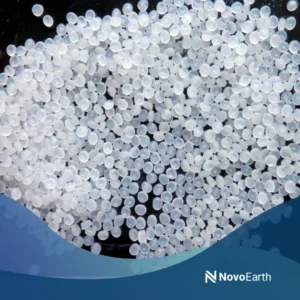
Polylactic Acid (PLA) is one of the most widely produced compostable polymer materials in the global bioplastics market.
It is produced from renewable resources such as corn starch or sugarcane and is commonly used in biodegradable product manufacturing.
PLA currently represents over 40% of global bioplastics production capacity, making it one of the most commercially important compostable polymer materials.
PBAT is a flexible, compostable polymer widely used in applications where durability and elasticity are required.
PBAT is particularly useful when flexibility is required, as PLA alone can sometimes be brittle.
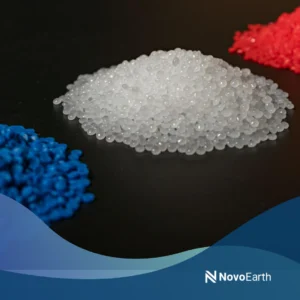
Polyhydroxyalkanoates (PHA) are a family of bio-based, compostable polymer materials produced by microorganisms through fermentation processes.
Because they originate from biological systems, PHA polymers are considered among the most promising next-generation sustainable polymers.
PHA is particularly attractive because it can biodegrade in more natural environments compared to many other compostable polymers.
Starch-based polymers are created by blending natural starch with biodegradable synthetic polymers to improve performance.
These polymers help reduce dependency on fossil-based plastics while improving sustainability.
Polymer Type | Source | Key Strength | Typical Applications |
PLA | Renewable crops | Rigid and transparent | Consumer products |
PBAT | Synthetic biodegradable polymer | Flexible and durable | Films and flexible materials |
PHA | Microbial fermentation | Marine biodegradable | Specialty applications |
Starch-Based Polymers | Plant starch | Cost-effective | Industrial packaging |
This diversity shows that different compostable polymer materials serve different industrial requirements.
Developing sustainable materials requires both polymer innovation and circular waste management systems.
NovoEarth focuses on:
Through material science innovation, NovoEarth is working toward eliminating microplastics and accelerating the adoption of compostable polymer materials across industries.
The global bioplastics industry is growing rapidly.
Industry forecasts suggest:
Future innovations are expected in:
Compostable polymer materials are plastics that biodegrade into carbon dioxide, water, and biomass under composting conditions.
Yes. Compostable polymers are a subset of biodegradable polymers that meet specific composting standards.
Most compostable polymers degrade within 90–180 days in industrial composting environments.
Industries using compostable polymer materials include:
They offer reduced environmental impact, especially when combined with proper waste management systems.
If your organization is exploring Compostable Polymer Materials or looking for sustainable alternatives to conventional plastics, NovoEarth is developing advanced biodegradable polymer technologies designed to reduce microplastic pollution.
Visit NovoEarth.co to learn how sustainable polymer innovation can transform the future of materials.
Sarthak Gupta is a Mechanical Engineer and the founder of NovoEarth, a cleantech venture specialising in circular material innovation and sustainable polymer solutions.
His expertise lies in biodegradable polymer technologies and recycling systems for multilayer plastics—complex waste streams traditionally considered non-recyclable.
With prior research and development experience in renewable energy and wind turbine design, Sarthak focuses on translating engineering innovation into scalable, commercially viable climate solutions.