
Close

If you’re a manufacturer, sustainability manager, startup founder, or policymaker, you’re likely under pressure to reduce plastic waste and adopt eco-friendly materials.
Traditional plastics take 400–500 years to degrade, contributing to over 350 million tonnes of global plastic waste annually. Even worse, they break down into microplastics, which persist in ecosystems and industrial systems.
So what’s the solution?
Biodegradable alternatives to plastic are emerging as a scalable, practical way to replace conventional plastics—without compromising performance or durability.
Biodegradable alternatives to plastic are materials designed to naturally break down into water, carbon dioxide, and biomass under controlled environmental conditions.
Unlike traditional plastics, these materials:
Issue | Data |
Global plastic waste | 350+ million tonnes/year |
Recycling rate | Only ~9% recycled globally |
Decomposition time | 400–500 years |
Microplastic presence | Found in 90% of industrial environments |
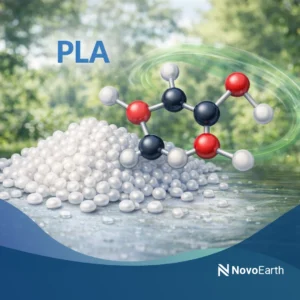
Limitations: Requires controlled composting conditions
Key Advantage: No toxic residue
Material | Degradation Time | Strength | Key Use |
PLA | 6–12 months | Medium | Rigid products |
PHA | 3–6 months | High | Industrial components |
Starch blends | 3–6 months | Low–Medium | Flexible materials |
Cellulose | 2–5 months | Medium | Films & coatings |
PBS | 6–12 months | High | Durable applications |
Let’s be realistic—this transition isn’t perfect yet.
If someone tells you biodegradable materials are a “perfect replacement”—they’re oversimplifying. The real advantage lies in continuous material innovation and system-level integration.
NovoEarth is not just another materials company—it’s working at the intersection of circular economy + advanced polymer science.
Key Differentiator:
Instead of just replacing plastic, NovoEarth is redesigning how materials behave after use.
The biodegradable polymers market is expected to grow at a 15–20% CAGR, reaching over $25 billion by 2030.
You should seriously consider switching if:
Not always. Their impact depends on disposal conditions and material type.
No. Some require industrial composting facilities.
Some (like PHA and PBS) can match or exceed conventional plastic performance.
Yes, properly designed biodegradable polymers break down without forming persistent microplastics.
Biodegradable alternatives to plastic are no longer optional—they’re becoming essential.
But the shift isn’t just about replacing materials.
It’s about rethinking the lifecycle of products.
Companies that adopt early will gain:
If you’re looking to transition to biodegradable alternatives to plastic, NovoEarth can help you:
👉 Visit NovoEarth.co to explore sustainable polymer solutions today
Sarthak Gupta
Mechanical Engineer | Founder, NovoEarth
Sarthak Gupta is a Mechanical Engineer and the founder of NovoEarth, a cleantech venture specialising in circular material innovation and sustainable polymer solutions. His expertise lies in biodegradable polymer technologies and recycling systems for multilayer plastics—complex waste streams traditionally considered non-recyclable. With prior Research and Development experience in renewable energy and wind turbine design, Sarthak focuses on translating engineering innovation into scalable, commercially viable climate solutions.