
Close

If you are a sustainability manager, manufacturer, policymaker, student, ESG consultant, or business leader exploring eco-friendly materials, this guide is for you.
Traditional plastics have become deeply embedded in industrial systems — but at a cost. Over 400 million tons of plastic waste are generated annually, and less than 10% is recycled. Microplastics are now detected in oceans, soil, air, and even human blood.
So how do we maintain material performance while reducing environmental damage?
Biodegradable polymers offer a science-backed pathway toward sustainability. This blog explains how biodegradable polymers contribute to sustainability across waste reduction, carbon footprint, circular economy, and microplastic mitigation.
Biodegradable polymers are materials designed to break down into natural elements like water, carbon dioxide (or methane), and biomass through microbial activity.
Unlike petroleum-based plastics that can persist for centuries, biodegradable polymers are engineered to degrade under composting or biological conditions — reducing long-term environmental accumulation.
Companies like NovoEarth are advancing biodegradable polymers specifically engineered for industrial scalability while addressing persistent plastic and microplastic challenges.
One of the most direct ways biodegradable polymers contribute to sustainability is by reducing persistent plastic accumulation.
This significantly reduces landfill load and environmental leakage.
In industrial packaging and agriculture, where high volumes of plastic are used, switching to biodegradable polymers can reduce long-term soil and landfill contamination.
NovoEarth focuses on converting complex organic waste into biodegradable polymer solutions, helping prevent materials from becoming long-term environmental pollutants.
Biodegradable polymers often have a lower life-cycle carbon footprint than petroleum-based plastics.
By reducing reliance on virgin fossil resources, biodegradable polymers contribute to climate change mitigation.
Microplastics are one of the most urgent environmental issues today.
Conventional plastics fragment into smaller particles but do not fully biodegrade, leading to:
Properly engineered biodegradable polymers are designed to break down biologically rather than fragmenting into persistent microplastics.
NovoEarth’s material innovation strategy specifically targets reducing microplastic generation from industrial and multilayer plastic waste streams.
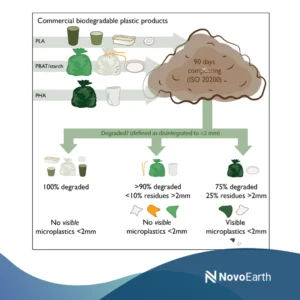
ISO 20200 is not for composting; it is to measure the level of disintegration at the lab scale, and ISO 17088 is for compostability.
Sustainability is not just about degradation — it’s about circular systems.
Biodegradable polymers support:
By designing materials that return safely to biological cycles, industries move closer to circular economy principles.
NovoEarth’s approach integrates circular material innovation with industrial-scale polymer engineering, ensuring performance and sustainability coexist.
Governments in over 60 countries have introduced plastic bans or restrictions.
Corporations are committing to:
Biodegradable polymers contribute to sustainability by helping industries meet these regulatory and ESG commitments.
Sustainability Factor | Biodegradable Polymers | Conventional Plastics |
Decomposition Time | Months (controlled conditions) | 400+ years |
Carbon Footprint | Lower lifecycle emissions | High fossil-based emissions |
Microplastic Impact | Reduced long-term persistence | Significant |
Circular Potential | Compostable systems | Linear waste model |
While biodegradable polymers contribute to sustainability, challenges remain:
However, as the industrial scale increases, costs continue to decline, and infrastructure expands. NovoEarth is working on an additional formulation which will degrade naturally under normal conditions, leaving no toxic trace behind and eliminating the dependency on composting infrastructures.
Biodegradable polymers contribute to sustainability by reducing long-term plastic waste, lowering carbon emissions, minimizing microplastic accumulation, and supporting circular economy systems.
No material has zero impact, but biodegradable polymers significantly reduce persistent pollution compared to conventional plastics.
Yes. Modern biodegradable polymers are engineered for packaging, agriculture, automotive, and logistics sectors.
NovoEarth has developed a scalable biodegradable polymer solutions focused on industrial performance, multilayer plastic replacement, and the reduction of persistent microplastic generation. The material is ISO 17088 certified.
Sustainability is no longer optional — it’s foundational to industrial resilience.
If your organisation is evaluating materials that contribute meaningfully to sustainability, NovoEarth offers biodegradable polymer solutions designed for real-world industrial impact.
👉 Connect with NovoEarth to explore sustainable polymer integration.
👉 Build systems that reduce microplastics and support circular material innovation.
Sarthak Gupta
Mechanical Engineer | Founder, NovoEarth
Sarthak Gupta is a Mechanical Engineer and the founder of NovoEarth, a cleantech venture specialising in circular material innovation and sustainable polymer solutions. His expertise lies in biodegradable polymer technologies and recycling systems for multilayer plastics—complex waste streams traditionally considered non-recyclable. With prior Research and Development experience in renewable energy and wind turbine design, Sarthak focuses on translating engineering innovation into scalable, commercially viable climate solutions.