
Close

If you’re a manufacturer, brand owner, packaging buyer, sustainability professional, policymaker, or eco-conscious business, this guide about Biodegradable Polymers is written especially for you.
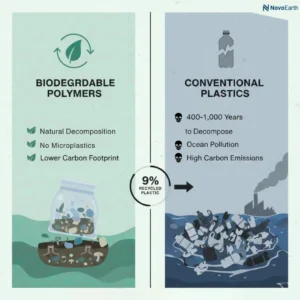
Traditional plastics take 400–1,000 years to decompose, clog landfills, pollute oceans, and increase carbon emissions. With plastic bans rising globally, businesses are struggling to find practical, scalable alternatives.
That’s where biodegradable polymers come in—materials designed to break down naturally, reduce environmental impact, and still perform like conventional plastics.
In this blog, we’ll break down:
Biodegradable polymers are materials that decompose naturally through the action of microorganisms like bacteria and fungi into water, carbon dioxide, and biomass.
Unlike conventional plastics, biodegradable polymers:
📊 Fact: According to global waste studies, only 9% of plastic ever produced is recycled, while biodegradable polymers help reduce landfill dependency significantly.
Biodegradable polymers are broadly classified into natural and synthetic biodegradable polymers.
Type | Source | Example |
Natural | Plants & animals | Starch, cellulose, PHA |
Synthetic | Chemically synthesized | PLA, PBAT , PBS |
Synthetic biodegradable polymers are man-made polymers engineered to decompose under specific environmental conditions, like composting or soil exposure.
They combine performance + sustainability, making them ideal for industrial use.
📊 Performance Insight: Synthetic biodegradable polymers can reduce greenhouse gas emissions by 30–70% compared to petroleum-based plastics.
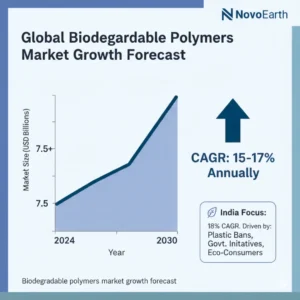
The market is growing rapidly due to sustainability regulations and consumer demand.
Metric | Value |
Global Market Size (2024) | USD 7.5 billion |
Expected Market Size (2030) | USD 22+ billion |
CAGR | 15–17% annually |
🌱 India Focus:
India’s biodegradable polymers market is expected to grow at 18% CAGR, driven by:
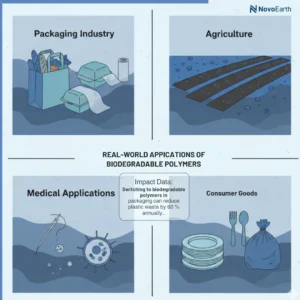
Here’s how biodegradable polymers are already being used in everyday life:
📊 Impact Data: Switching to biodegradable polymers in packaging can reduce plastic waste by up to 60% annually for FMCG brands.
Many people confuse biodegradable polymers with compostable ones.
Feature | Biodegradable Polymers | Compostable Polymers |
Breakdown | Natural environments | Compost conditions |
Timeframe | Variable | Fixed (90–180 days) |
Certification | Optional | Mandatory |
👉 Key Takeaway: All compostable polymers are biodegradable, but not all biodegradable polymers are compostable.
📈 Consumer Insight: 73% of consumers prefer brands using sustainable packaging.
Yes, when disposed of correctly, biodegradable polymers significantly reduce pollution and waste.
Depending on the material and conditions, 3 months to 2 years.
Initially, yes, but costs are dropping by 10–15% annually due to scaling and innovation.
Not entirely yet, but they are ideal for packaging, agriculture, and disposables.
At NovoEarth, we specialise in next-generation biodegradable polymers designed for real-world performance and sustainability.
Partner with NovoEarth.co to future-proof your business with innovative biodegradable polymer solutions.
Visit: https://novoearth.co
Talk to our sustainability experts today
Sarthak Gupta is a Mechanical Engineer and the founder of NovoEarth, a cleantech venture specialising in circular material innovation and sustainable polymer solutions. His expertise lies in biodegradable polymer technologies and recycling systems for multilayer plastics—complex waste streams traditionally considered non-recyclable. With prior experience in renewable energy and wind turbine design, Sarthak focuses on translating engineering innovation into scalable, commercially viable climate solutions.