
Close

If you’re a manufacturer, sustainability officer, student, procurement manager, or business owner exploring sustainable materials, this guide is for you.
There’s growing pressure to replace conventional plastics. But before switching, most decision-makers want clarity on biodegradable polymers and their applications, as well as the biodegradable polymers advantages and disadvantages in real industrial environments.
Without clarity, companies risk choosing materials that don’t meet performance, cost, or regulatory expectations.
This blog simplifies everything — explaining biodegradable polymers, their industrial and commercial applications, and clearly outlining their advantages and disadvantages with real data.
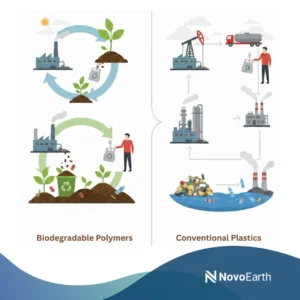
Biodegradable polymers are materials that break down into water, carbon dioxide (or methane), and biomass through natural biological processes involving microorganisms.
Unlike conventional plastics that can take 400–500 years to degrade, biodegradable polymers are designed to decompose in months under industrial composting conditions.
Modern biodegradable polymers are engineered for:
Companies like NovoEarth are developing biodegradable polymers that not only degrade safely but also help reduce long-term microplastic generation from multilayer plastic waste streams.
Let’s explore biodegradable polymers and their applications across industries.
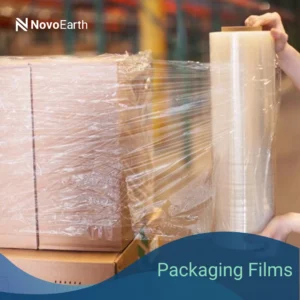
Packaging represents nearly 45% of global biodegradable polymer demand.
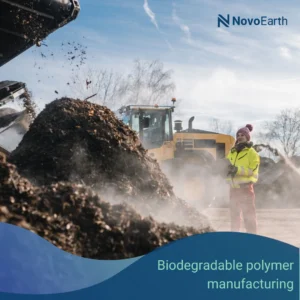
NovoEarth produces biodegradable polymers engineered for industrial packaging and logistics, enabling businesses to shift away from conventional multilayer plastics.
Applications include:
Traditional agricultural plastics leave microplastic residues in soil. Biodegradable polymers eliminate post-harvest removal costs and reduce soil contamination.
NovoEarth is actively producing biodegradable mulch films that degrade safely under soil conditions.
Biodegradable polymers in healthcare reduce the need for secondary surgical removal procedures.
Certain biodegradable polymers reduce lifecycle emissions by 30–70% compared to petroleum plastics.
Understanding biodegradable polymers advantages and disadvantages is critical before adoption.
They decompose faster than traditional plastics, reducing long-term landfill accumulation.
Some biodegradable polymers emit up to 60–70% less greenhouse gases during production.
Properly engineered biodegradable polymers minimize persistent microplastic formation.
Modern formulations run on existing extrusion and molding lines.
Help industries meet plastic bans and ESG targets.
Typically 10–30% more expensive than conventional plastics.
Many biodegradable polymers require industrial composting conditions.
Mixing with conventional plastic streams can complicate recycling.
Not all biodegradable polymers perform equally under extreme heat or load.
Factor | Advantages | Disadvantages |
Environmental Impact | Reduces landfill waste | Requires a composting system |
Carbon Emissions | Lower lifecycle emissions | Production scale still developing |
Industrial Use | Compatible with machinery | Slightly higher cost |
Microplastics | Reduced long-term residue | Not fully eliminated in all cases |
The global biodegradable polymers market:
Industrial packaging and agriculture are leading segments.
India’s regulatory push and circular economy focus are accelerating demand for scalable solutions like those being developed at NovoEarth.
Biodegradable polymers are materials designed to decompose naturally through biological processes. Their applications include packaging, agriculture, healthcare, automotive components, and industrial films.
Advantages include lower environmental impact, reduced microplastic accumulation, and lower carbon emissions. Disadvantages include higher cost and need for composting infrastructure in some cases.
In terms of environmental sustainability and microplastic reduction, yes. However, performance and cost considerations must be evaluated case-by-case.
NovoEarth is developing advanced biodegradable polymers focused on industrial scalability, plastic film replacement, and the reduction of persistent microplastic waste streams.
Sustainable materials are no longer optional — they are a competitive advantage.
If your organisation is evaluating biodegradable polymers and their applications, NovoEarth can help you transition with performance-driven, scalable solutions tailored for industrial use.
👉 Connect with NovoEarth to explore biodegradable polymer integration.
👉 Build circular, microplastic-reducing material systems today.
Sarthak Gupta
Mechanical Engineer | Founder, NovoEarth
Sarthak Gupta is a Mechanical Engineer and the founder of NovoEarth, a cleantech venture specialising in circular material innovation and sustainable polymer solutions. His expertise lies in biodegradable polymer technologies and recycling systems for multilayer plastics—complex waste streams traditionally considered non-recyclable. With prior Research and development experience in renewable energy and wind turbine design, Sarthak focuses on translating engineering innovation into scalable, commercially viable climate solutions.